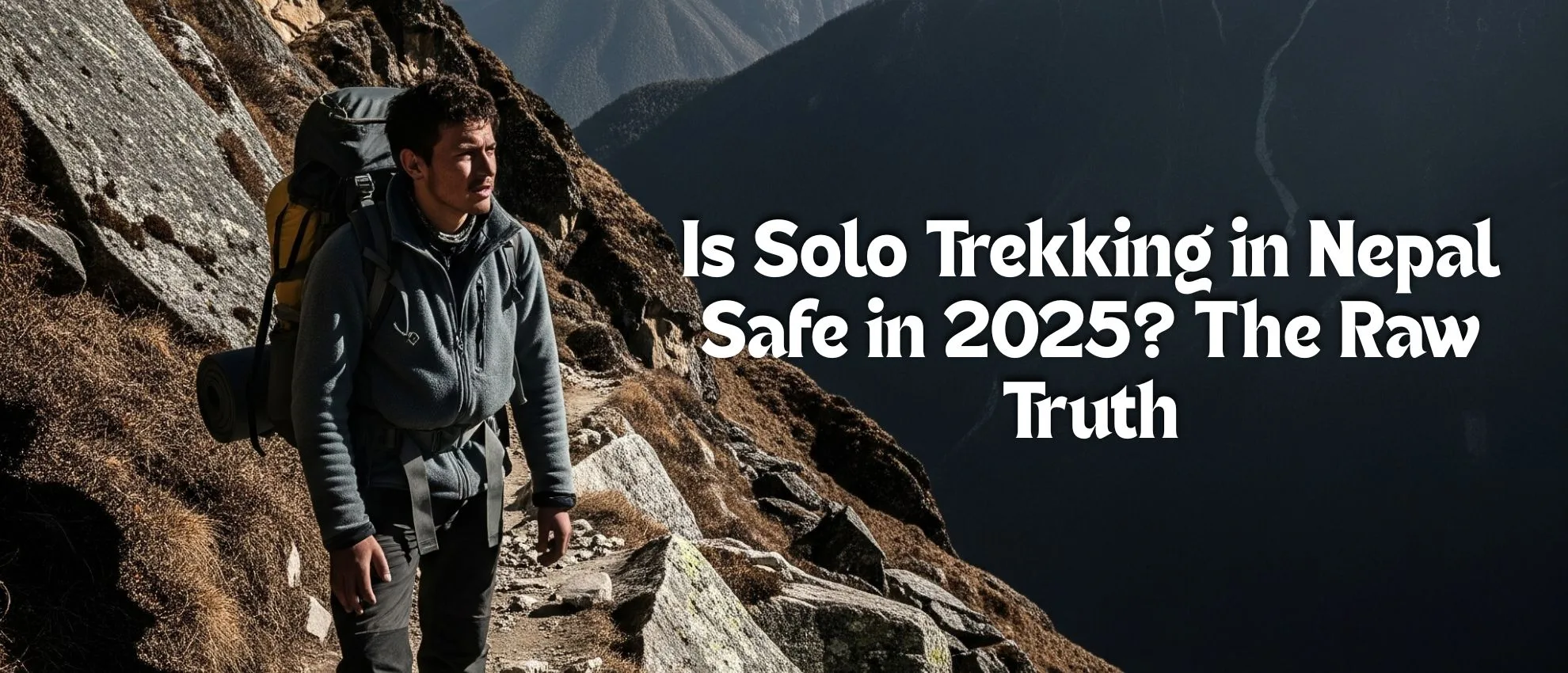
Yes, solo trekking in Nepal is still possible in 2026, but only in a few places. Since 1 April 2023, foreign trekkers need a licensed guide in most national parks and conservation areas, and the main exception in practice is the Everest (Khumbu) region, where the local municipality has not enforced the rule.
Last checked: November 2026.
Let’s cut through the noise. You’re not here for sugar-coated tips or packaged advice. You’re not asking if Nepal is “safe” like some travel blogger planning a photoshoot. You’re asking because you’re serious about walking into the Himalayas with nothing but your boots, your pack, and a head full of questions only the trail can answer. You want to go solo, and you want to know if Nepal will let you.
Solo trekking in Nepal is still powerful. Still one of the most honest things you can do. But the game has changed, and you’d better understand exactly what you’re stepping into. If you’re weighing up the Everest region, our Everest Base Camp Trek page shows the full route.
Nepal Changed the Rules, and You Need to Know Why
On 1 April 2023, the Nepal Tourism Board brought in a rule that foreign trekkers in national parks and conservation areas must trek with a licensed guide booked through a registered trekking agency. At the same time, TIMS cards stopped being sold to independent trekkers: they are now issued only through registered agencies, at NPR 2,000 per foreign trekker (NPR 1,000 for SAARC nationals). This wasn’t random. It came after years of people getting lost, altitude rescues that drained local resources, and too many avoidable tragedies.
In 2026, checkpoints on the main routes ask for your permits and, in most protected areas, your guide. If you don’t have them, you can be turned back or fined. No permit, no passage. In most of the country, no guide, no entry.
There’s one big exception in practice. On paper, the Nepal Tourism Board’s rule covers the Everest region too. But the Khumbu Pasang Lhamu Rural Municipality, which covers the Everest region, said in 2023 that it would not follow the rule, and it still has not strictly enforced it, so independent trekking remains common on the main Everest routes. Trekkers there buy the municipality’s local permit and a Sagarmatha National Park permit instead of a TIMS card. Because the national rule still technically applies, this could change, so check the current position before you go.
Where You Can’t Trek Alone in 2026
If your dream trek is inside a national park or conservation area, you need a licensed guide. That includes:
- Annapurna Circuit and Annapurna Base Camp
- Ghorepani–Poon Hill and Ghandruk (both inside the Annapurna Conservation Area)
- Mardi Himal and Australian Camp to Dhampus (also inside ACAP)
- Langtang Valley
- Manaslu Circuit
- Nar Phu Valley
- Upper Mustang
- Tsum Valley
- Dolpo and other restricted areas
Restricted areas go one step further. Manaslu, Nar Phu, Upper Mustang, Tsum and Upper Dolpo need a Restricted Area Permit issued through a registered agency, and you must trek with a licensed guide. Until March 2026 these permits were only issued to groups of at least two foreign trekkers. Since late March 2026, a single trekker can get a restricted area permit, as long as a licensed guide goes with them. So a solo traveller can now go, but not unguided.
Where You Can Still Trek Solo
There are still places that let you walk alone, for now:
- The Everest region: Everest Base Camp, Gokyo, the Three Passes. Independent trekking continues here because the local municipality does not enforce the guide rule, even though the national rule lists these routes.
- Day hikes and short walks outside national parks and conservation areas, such as Nagarkot to Dhulikhel on the Kathmandu Valley rim. The 2023 rule is aimed at protected areas, but take an offline map, as some of these routes are easy to lose.
Shivapuri, just north of Kathmandu, sits inside Shivapuri Nagarjun National Park, so the guide rule can apply there too, and local operators report that a guide is expected. Check before you go.
But here’s the catch: even these can change. National and local authorities can bring in stricter rules or start enforcing existing ones at any time. If you’re banking your whole trek on walking solo without checking the latest policy, you’re already making mistake number one.
| Region | Solo allowed in 2026? | Permits you need |
|---|---|---|
| Everest (Khumbu) | In practice yes, as the local municipality does not enforce the guide rule (it is still on the national books) | Khumbu Pasang Lhamu local permit (NPR 3,000) and Sagarmatha National Park permit (NPR 3,000, some sellers add 13% VAT) |
| Annapurna (incl. Poon Hill, ABC, Mardi) | No, licensed guide required | ACAP (NPR 3,000) and TIMS (NPR 2,000) |
| Langtang | No, licensed guide required | Langtang National Park permit (NPR 3,000, often quoted with 13% VAT) and TIMS (NPR 2,000) |
| Restricted areas (Manaslu, Mustang, Dolpo, Nar Phu, Tsum) | No, licensed guide required (a single trekker can now get the permit, but must have a guide) | Restricted Area Permit plus conservation area or national park permits; fees vary by area and season |
Solo trekking isn’t just about going alone; it’s about owning everything that happens.
You go solo, you take full responsibility. No one to check your symptoms when the altitude creeps in. No one to call for help when you twist your ankle on a rock-strewn trail. No one to tell you you’re pushing too hard, walking too fast, drinking too little, or ignoring the signs your body is giving you.
That sounds like freedom. And it is.
But freedom has teeth. If you’re not ready to feel them, don’t go solo.
Here’s What Solo Trekkers Don’t Talk About
They’ll post the silence. The early mornings alone with the mountains. The pride of finding their own way.
What they won’t always tell you is how scary it gets when the fog rolls in and you lose the trail. When you haven’t spoken to another human in two days. When you wake up dizzy and alone, and there’s no one to notice that your lips are turning blue.
Solo trekking isn’t about escaping others. It’s about facing yourself. And most people aren’t prepared for that kind of mirror.
Want to Trek Solo in 2026? Here’s How to Be Smart About It
If you’re going to do this, do it with respect, not just for the mountains but for your own life.
- Pick the right trail. In 2026 that mostly means the Everest region. Not every trek has to be 5,000 m and above the clouds; Namche and the lower Khumbu are a good start.
- Download offline maps. Not just Google: use Maps.me, Gaia GPS or OsmAnd.
- Tell someone your route. Lodge owners. A friend. Anyone.
- Stay at teahouses. Wild camping sounds fun until you’re rained on in a leech-filled forest.
- Always ask locals for updates. Sometimes a trail exists on a map but not on the ground anymore.
- Check the weather every single morning. Conditions in Nepal shift fast.
- Carry a power bank, extra cash, and enough water.
- Plan for flight delays. In the busy spring and autumn seasons, most Lukla flights leave from Ramechhap (Manthali), roughly a 5-hour drive from Kathmandu, and bad weather at Lukla can leave you waiting there for days.
- Don’t chase the summit if your gut says turn back. Real trekkers listen.
Guides Aren’t a Sign of Weakness; They’re the Reason You’ll Go Further
If you still want that solo feel but need a safety net, or you want to trek outside the Everest region, hire a porter-guide. They’re not there to hold your hand. They’re there to have your back. They’ll carry part of your load, help with permits, talk to locals, and step in only when things get rough.
One thing to check: the 2023 rule refers to licensed trekking guides booked through a registered agency. Porter-guides hold different levels of licence, so ask the agency to confirm in writing that your porter-guide’s licence meets the rule for your route.
You still walk your own path. You just don’t have to risk everything to prove it.
Is It Still Worth Trekking Solo in Nepal in 2026?
That depends. Are you doing it because you need to prove something? Or because you feel called to walk alone and listen to what the trail teaches you?
If it’s the second, then yes. Nepal still has room for you. The Himalayas are still waiting. But they’ll demand that you meet them with humility, respect, and preparation.
Go solo, but don’t go stupid. Because out there, mistakes don’t always get second chances.
At Blaze Mountain, We’re Here for Real Trekkers, Not Tourists
We don’t do tourist bus drop-offs and scripted itineraries. We don’t treat you like a customer. We treat you like someone who belongs on the trail.
We’ll help you figure out where you can go solo, where you can’t, and what kind of guide actually adds value to your trek. No hard sell. Just honest advice from people who live and work in these mountains.
FAQ
Can I trek to Everest Base Camp without a guide in 2026?
In practice, yes. The national guide rule technically covers the Everest region, but the Khumbu Pasang Lhamu Rural Municipality has not enforced it, so independent trekkers still walk to Everest Base Camp with the local municipality permit and the Sagarmatha National Park permit. Check the latest position before you travel, as enforcement could change.
Can I do Poon Hill solo?
No. Poon Hill is inside the Annapurna Conservation Area, where the 2023 rule requires a licensed guide for foreign trekkers.
I’m travelling alone. Can I still do a restricted-area trek?
Yes. Since March 2026, a single trekker can get a restricted area permit through a registered agency, so you no longer need to find a second trekker. You still need a licensed guide for the whole trek.
Is Nepal safe for solo women trekkers?
Nepal is generally safe, and the main risks on the trail are altitude, weather and injury rather than crime. A licensed guide, a well-known teahouse route and a shared itinerary with someone at home reduce the risk further.
If you want honest advice on your route, read our Everest Base Camp Trek page or contact us with your dates. You may also find “How Much Does Trekking in Nepal Cost in 2026?” useful.
Featured Himalayan Trekking Packages
Annapurna Base Camp
12 Days | Max Alt: 4,130m | 360° Himalayan Amphitheater
Khayer Lake Trek
15 Days | Khopra Danda Ridge (4,660m) | Sacred Glacial Lake
Upper Mustang Trek
16 Days | Lo Manthang (3,840m) | Tibetan Culture & Rain Shadow
Lower Dolpo Trek
16 Days | Shey Phoksundo Lake (3,611m) | Deep Mountain Wilderness